5 Best AI Tools for Greenhouses, Nurseries and Garden Centers in 2026
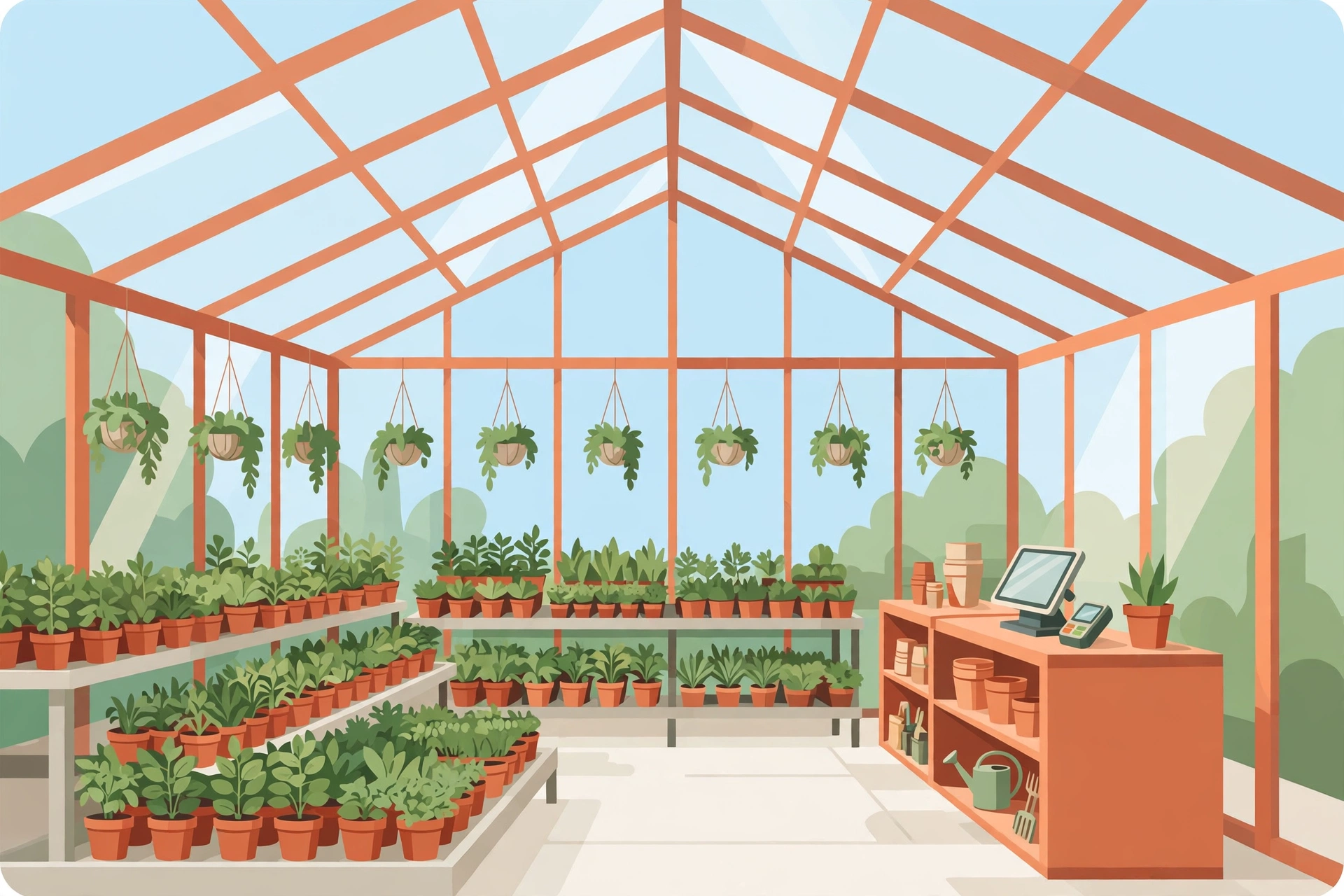
A garden center is two businesses sharing one roof. Out front, customers buy a flat of petunias, a bag of mulch, and a ceramic pot in a single transaction. Out back, someone is potting up cuttings that will not be sellable for eight weeks, and the availability list for wholesale buyers is already out of date. Most retail software handles the front half fine and ignores the back half entirely. Most farm software does the reverse.
This list splits the buyer on purpose. If you run a retail garden center, you need a point of sale that understands living inventory: flats, cubic yards, bulk soil, plants that die on the bench, and seasonal stock that is worthless by July. If you grow wholesale, you need production planning and availability lists that buyers can actually rely on. We ranked five tools on those two jobs, using published 2026 pricing, and named a pick for each side of the business.
Our pick in one line: small growers should start with Tend at $30 a month; retail garden centers should start with Square Retail free and upgrade to Plus at $49 when purchase orders matter.
Quick-pick summary
| Tool | Best For | Starting Price | Free Tier |
|---|---|---|---|
| Tend | Small growers and production planning | Free; Pro $30/mo | Yes |
| Square Retail | Retail garden centers starting out | Free; Plus $49/mo per location | Yes |
| Farmbrite | Small diversified farms with a nursery arm | From $29/mo | No (14-day trial) |
| Planting Nursery | Wholesale nurseries needing lot-level tracking | From $289/feature/mo | No (free trial) |
| Lightspeed Retail | Multi-location garden centers | Basic $89/mo billed annually | No (14-day trial) |
How we picked
We scored each tool on living-inventory handling (flats, bulk, and perishable stock), production planning or availability lists, point-of-sale strength, published pricing, and fit for a small operation rather than a large enterprise. Pricing was checked against the vendors’ pricing pages in November 2026; confirm before you buy, because nursery software reprices quietly. Two well-known names are deliberately absent from the ranked five: SBI and ET Grow are quote-only ERP systems built for large growers, and scoring them against $30-a-month tools would be dishonest. If you run a large wholesale operation, get quotes from both — but do not compare their price to anything on this list.
1. Tend — Best for small growers and production planning
Tend is farm management software built around the crop plan, and that is exactly what a small grower needs. You build the season once — what is planted, where, and when — and Tend turns it into tasks, harvest dates, and yield and revenue projections. For a nursery, the same logic covers successions of annuals, potted perennials, and cut flowers: the plan tells you what should be ready in which week, instead of you discovering it on the bench.
Pricing: Free for one user. Pro is $30 a month for up to five users, with roughly a third off on annual billing. Unlimited is $75 a month. The free tier is genuinely usable for a one-person grower testing whether crop planning software fits the operation.
Pros:
- Visual crop planner with a preloaded crop library, so succession plantings and growing templates do not start from a blank page
- Automatic task generation from the crop plan, with yield and revenue projections by day, week, or month
- Sales tools built in: online store, wholesale orders, and farmers market sales in one place
- Receipt scanning and farm accounting keep the books close to the growing records
Cons:
- It is grower software, not a retail POS — a garden center with a busy counter still needs a separate till
- No published per-user price above the Unlimited tier, so a larger crew needs to check the current plan page
2. Square Retail — Best for retail garden centers starting out
Square Retail is the easiest way for a small garden center to get a competent counter running. The free plan includes the POS app, an item library with automatic SKUs, stock tracking with low-stock alerts, and a basic online store — enough to sell through spring without a monthly bill. The upgrade that matters is Plus at $49 a month per location, which adds purchase orders, vendor management, cost-of-goods reporting, and barcode label printing. Those four features are the difference between a till and an inventory system, and for a garden center ordering flats by the hundred, they pay for themselves in the first busy month.
Pricing: Free is $0 a month per location; Plus is $49 a month per location; Premium is $149 a month per location. In-person card rates are 2.6% + 15 cents on Free, 2.5% + 15 cents on Plus, and 2.4% + 15 cents on Premium. Plus and Premium include a 30-day free trial.
Pros:
- Free tier is real and usable, so a seasonal center can open without committing to a subscription
- Purchase orders and cost reporting on Plus solve the two inventory jobs garden centers actually struggle with
- Hardware is cheap and familiar — a tablet and a card reader cover most counters
- Multi-location tools on Premium, including transfer orders between stores
Cons:
- No production planning or availability lists, so wholesale growers need a second system
- The card-rate saving from Plus is tiny (0.1 point); buy Plus for the inventory tools, not the rate — you would need about $49,000 a month in card sales for the rate alone to cover the fee
- Living inventory still needs manual discipline: Square tracks quantities, not plant health or shrink
3. Farmbrite — Best for small diversified farms with a nursery arm
Farmbrite is farm business software for operations that mix crops, livestock, and direct sales — which describes a surprising number of small nurseries that also run a farm stand or CSA. Its strength is the record-keeping spine: crop plans, task scheduling, inventory, customer orders, and farm accounting in one subscription, with no acreage limits on any plan. A nursery that also grows vegetables for a farm stand gets both sides of the business in one place instead of two logins.
Pricing: Crop Grower Essentials starts at $29 a month ($290 a year); Complete Essentials, which covers crops and livestock together, is $59 a month. A 14-day free trial is available, and qualifying new farmers get discounts of up to 50% off for three years. Note: some older listings still show a $35-a-month Grower tier — Farmbrite’s current pricing page lists Essentials from $29, and that is the figure to budget on.
Pros:
- One system for crops, sales, and accounting, with unlimited team members from the Performance tier up
- No acreage limits, which matters for nurseries spread across fields and greenhouses
- New-farmer and nonprofit discounts are unusually generous for this market
- 14-day free trial with no credit card required
Cons:
- The plan structure splits livestock, crop, and complete lines, so the price climbs if you add a second enterprise later
- Less nursery-specific than Tend or Planting Nursery — no lot-level plant tracking or availability lists built for wholesale buyers
- No free tier beyond the trial
4. Planting Nursery — Best for wholesale nurseries needing lot-level tracking
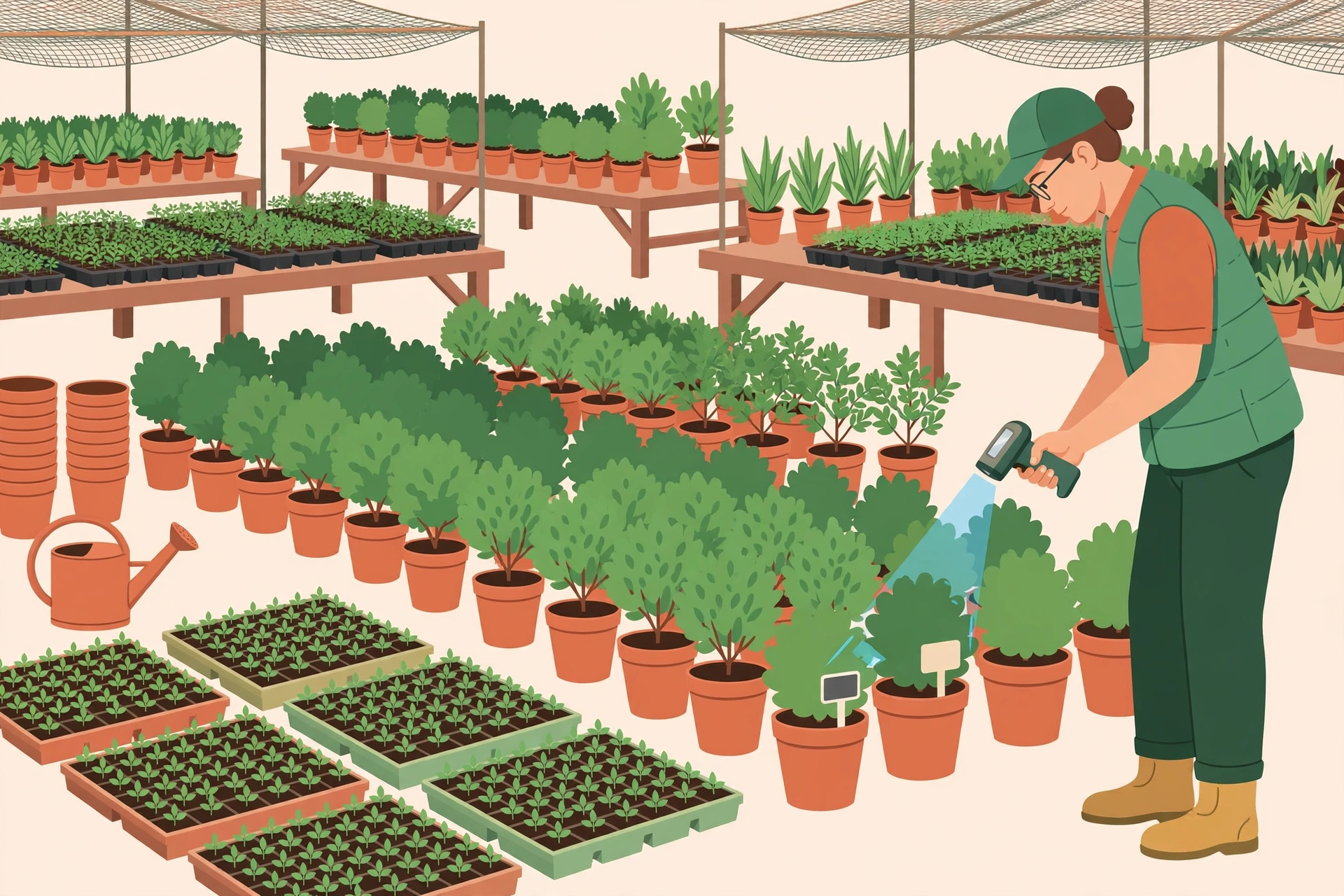
Planting Nursery is the only tool on this list built specifically for running a plant nursery end to end. It tracks plant stock by lot, quantity, and location across fields, greenhouses, and warehouses; ties that stock to production planning with scheduled tasks for sowing, potting, up-potting, trimming, and spraying; and produces availability lists from the same data. It also covers hardgoods, spray mixes, soil, chemical tracking, and re-entry reports — the unglamorous compliance work that wholesale growers actually get audited on.
Pricing: Basic starts at $289 per feature, per month, billed monthly, with a free trial available. Because pricing is per feature, your total depends on which modules you activate — inventory alone is one price, inventory plus production plus sales is materially more. Scope the modules before you sign, and get the total in writing.
Pros:
- True nursery-native design: lots, ready dates, planned vs. actual quantities, and availability reports
- Production tasks scheduled by week of the year, with a bill of resources per plant life cycle
- Mobile app for in-field reports on disease, water deficit, and chemical applications
- Built-in accounting, CRM, and order processing, so the office runs on the same data as the field
Cons:
- Per-feature pricing makes it the most expensive tool here by a wide margin once you add modules
- Overkill for a small retail garden center — this is wholesale production software, not a till
- No free tier, and the interface is built for operations staff rather than casual users
5. Lightspeed Retail — Best for multi-location garden centers
Lightspeed Retail is the pick when one garden center becomes two or three. It is a full retail POS with strong inventory management, built-in eCommerce, loyalty, and advanced reporting that grows with the business — Basic covers a single register and everyday retail, Core adds loyalty and deeper reports plus a mobile scanner app, and Plus adds forecasting, order recommendations, API access, and custom user roles. For a garden center group with thousands of SKUs across locations, that depth is the point.
Pricing: Basic is $89 a month, Core $149, and Plus $289, all billed annually ($109, $179, and $339 month to month). Each plan includes one register; additional registers and locations are priced separately and are not published, so get them quoted. Card processing runs through Lightspeed Payments and is charged on top — Lightspeed’s own pages have shown different card-present rates, so ask for the full rate in writing before you compare it against Square.
Pros:
- Strongest multi-location and catalog handling on this list, with built-in eCommerce on every tier
- Forecasting and order recommendations on Plus help with seasonal buying decisions
- 24/7 chat support on all plans; phone support on Plus
- Loyalty tools included from the Core tier up
Cons:
- No free plan, and the headline price excludes extra registers, extra locations, hardware, and processing
- No production planning — wholesale growers still need a second system
- The annual-billing discount is the only way to get the $89 entry price; month-to-month costs $109
Also considered
Rain POS deserves a look from single-location specialty retailers: Startup is $99 a month billed annually with POS, website, and unlimited users and products, and Rain now also publishes Core at $149 and Plus at $199 a month — earlier listings described those tiers as quote-only, so the published figures are a recent improvement. Its weakness for garden centers is the same as Square’s: it is a retail till, not a growing system. QuickFlora starts at $99 a month (Professional is $134 billed annually) but is built for florists and flower shops, not nurseries — worth it only if cut flowers and events are a large share of your sales.
How we compared
We weighted living-inventory handling and production planning highest, because those are the jobs generic retail and farm software both get wrong in a greenhouse. Price was scored on published figures only — quote-only tools were excluded from the ranked five rather than guessed at. The retail picks were judged on the counter and the stockroom; the grower picks were judged on the crop plan and the availability list. Pricing was checked against the vendors’ pricing pages in November 2026; confirm before you buy.
The verdict, by buyer
- Wholesale grower or nursery with production to plan: Tend if you are small, Planting Nursery if you are big enough to justify $289 a feature.
- Retail garden center, one location: Square Retail — free to start, Plus at $49 when purchase orders matter.
- Small farm with a nursery arm and a farm stand: Farmbrite from $29 a month.
- Two or more locations: Lightspeed Retail — budget registers, locations, and processing on top of the $89 headline.
The honest summary is that no single tool on this list does both jobs well. A grower who also retails will almost certainly run two systems — Tend or Planting Nursery out back, Square or Lightspeed out front — and the right question is not which one wins, but which half of the business is costing you more right now. Start there.
If you are weighing the retail side against other kinds of shops, our guides to the best AI tools for pet stores and the best AI tools for salons and spas cover the same POS-first buying logic, and the best AI tools for warehouses and 3PL providers is useful once inventory spans more than one location.
FAQ
What is the best software for a small greenhouse or nursery?
For a small grower, Tend at $30 a month for Pro is the best starting point — it covers crop planning, tasks, and sales in one place, and the free tier lets a one-person operation test it first. For a small retail garden center, Square Retail is the better start because the free plan covers the counter and the online store. Wholesale nurseries with lot-level tracking needs should look at Planting Nursery instead.
Do garden centers need nursery-specific software, or will a normal POS work?
A normal POS works for the counter, but it tracks quantities, not living stock. Plants grow, change size, and die; bulk soil sells by the cubic yard; flats split into individual pots. Nursery-specific tools like Tend and Planting Nursery handle production and availability, while a POS like Square or Lightspeed handles the sale. Most operations that both grow and retail end up running one of each.
How much does garden center software cost?
Published starting prices in November 2026 run from free (Tend for one user, Square Retail) to $29 a month (Farmbrite), $89 a month billed annually (Lightspeed Retail Basic), $99 a month billed annually (Rain POS Startup), and $289 per feature a month (Planting Nursery). Large-grower ERP systems such as SBI and ET Grow are quote-only and typically cost far more — budget them as a separate conversation, not a monthly subscription.
Can Square handle a garden center’s inventory?
Yes, with limits. Square Retail tracks stock quantities, low-stock alerts, and purchase orders on the $49-a-month Plus plan, which covers most retail garden centers. It does not track plant health, shrink, or production schedules, and it has no availability-list feature for wholesale buyers — for those jobs, pair it with a grower tool.
What is the difference between Tend and Planting Nursery?
Tend is crop-planning software for small diversified growers, priced from free to $75 a month, with sales tools built in. Planting Nursery is nursery-specific operations software for wholesale growers, priced from $289 per feature a month, with lot-level tracking, production scheduling, and availability lists. Tend fits a small grower; Planting Nursery fits a wholesale nursery with staff and volume to justify it.



0 comments