5 Best AI Tools for Farms and Agriculture in 2026
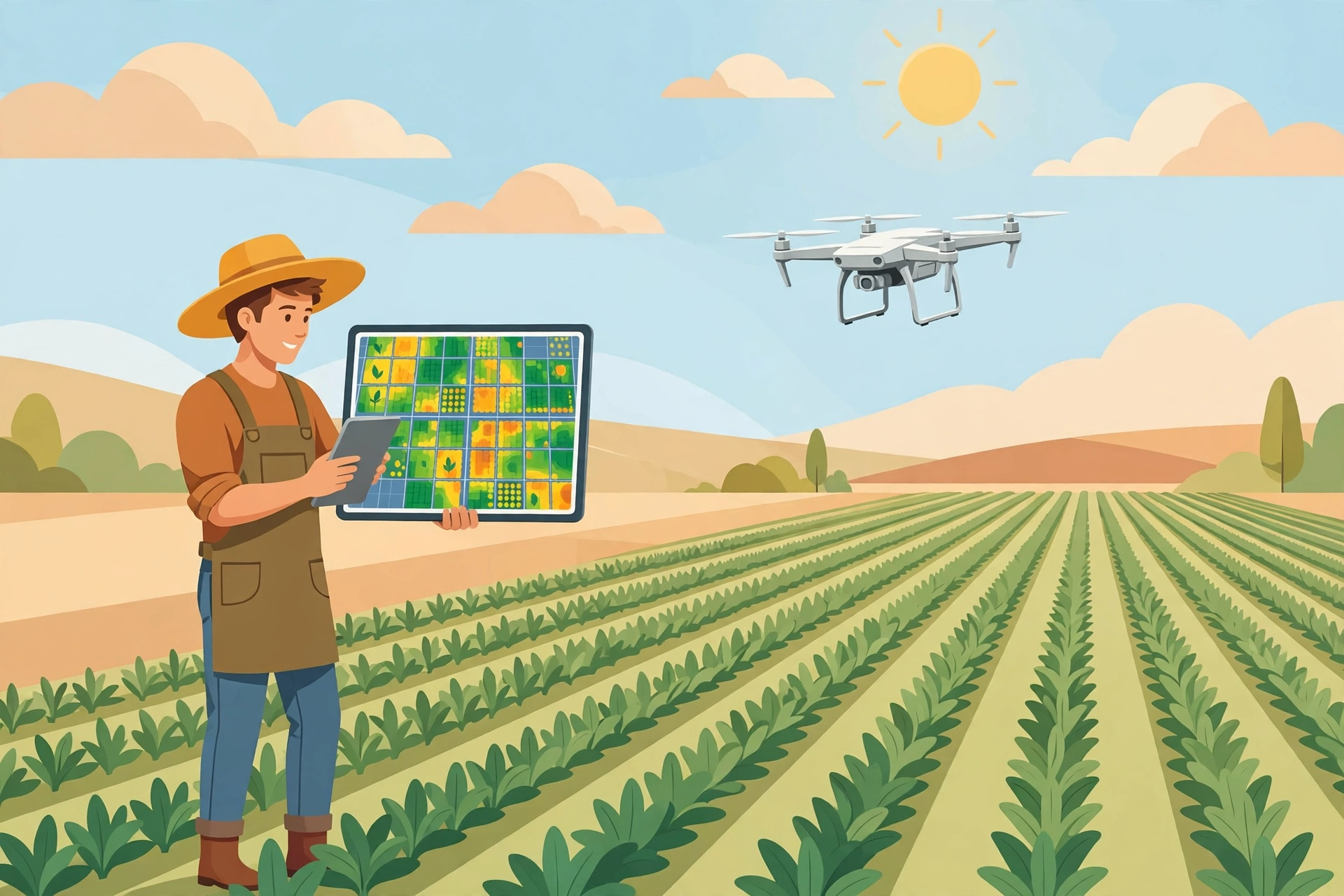
Farm AI has a credibility problem. Every platform promises higher yields, but most of what they sell is a prettier way to look at data you already had. The tools worth paying for do something narrower and more valuable: they spot a problem in a field before you can see it from the truck, and they turn that finding into a prescription your planter or sprayer can follow.
That is the bar we used for this list. We scored five tools on imagery and scouting quality, variable-rate prescriptions, equipment integration, and per-acre cost. Our number one pick is Climate FieldView — the free tier is genuinely useful, it works across equipment brands, and its seed and nitrogen scripting pays for itself on row-crop acres.
Quick picks: the 5 tools at a glance
| Tool | Best For | Starting Price | Free Tier |
|---|---|---|---|
| Climate FieldView | Row-crop farms with mixed equipment | Free; Plus from $649/year | Yes |
| Granular Insights | Field-level profitability | Free tier; paid plans quoted | Yes |
| Taranis | AI crop scouting at leaf level | Quote only | No |
| John Deere Operations Center | Farms already running Deere machines | Free platform | Yes |
| xarvio FIELD MANAGER | Spray timing and variable-rate maps on a budget | Free for two fields | Yes |
How the per-acre math works
Before the rankings, a word on cost. Farm software is priced in at least four different ways: free tiers, flat annual fees, per-acre subscriptions, and quote-only enterprise deals. A $649 annual plan is cheap on 1,200 acres and expensive on 40. Whenever a vendor publishes a per-acre figure, we give it; when they do not, we say so. The honest way to judge any of these tools is cost per acre against the input you expect to save — a nitrogen prescription that cuts 10 pounds of N per acre pays for a $4-per-acre tool twice over, and pays for nothing if your spreader cannot read the file.
1. Climate FieldView — Best overall for row crops
Best for: Corn, soybean, and other row-crop farms that want yield data, imagery, and prescriptions in one place.
FieldView is Bayer’s digital farming platform, and it is the default choice for a reason: it starts free, it works with equipment from more than one brand, and the paid tier adds the features that actually change decisions. The FieldView Drive collects machine data from the cab, and the platform layers satellite imagery, yield analysis, and field health monitoring on top. Bayer reports the platform is used on more than 220 million subscribed acres globally.
The free Basic tier covers data collection and storage, basic field mapping, and equipment connectivity. That alone replaces the thumb drive and the spreadsheet for a lot of operations. Plus adds field health imagery, scouting reports, data analysis, and zone management scripting — including seed scripts and nitrogen scripts built from your own field data. That scripting is the feature that justifies the upgrade: it tells the planter to drop more seed where the field has historically yielded well and less where it has not.
Pricing: Basic is free. Plus starts at $649 per year on FieldView’s own pricing page (checked November 2026). Note that some third-party roundups still cite an older per-acre figure of about $4 per acre per year for Plus; the vendor’s own page now lists the flat $649 starting price, so treat the per-acre number as outdated.
Pros:
- Free tier is genuinely usable, not a demo
- Works across equipment brands, not just one color of tractor
- Seed and nitrogen scripting built from your own yield history
- Field health imagery included in the paid tier
Cons:
- It is a Bayer product, and some growers prefer an independent platform for their data
- The jump from free to paid is a flat annual fee, which stings on small acreage
- Advanced analytics still need good machine data to be worth much
2. Granular Insights — Best for field-level profitability
Best for: Growers who want to know which fields actually make money.
Granular Insights, from Corteva Agriscience, answers a different question than FieldView. Instead of starting with imagery, it starts with the books: it stitches together machine data, invoices, and field operations into a profitability view per field. If you have ever wondered whether your worst-yielding 40 acres are worth farming at all, this is the tool built to answer that.
The platform includes satellite imagery and yield analytics on paid plans, and a free tier gets you started with the basics. Where it earns its keep is in the planning workflow — crop planning, activity records, and cost tracking in one place, so the agronomy and the accounting stop living in separate apps.
Pricing: A free tier is available. Corteva does not publish list pricing for paid plans — its pricing page redirects to an app login, and buyers are sent to sales. Third-party reports disagree on the starting point, citing figures from $649 to $1,200 per year for the entry business tier and around $2,400 per year for the full Insights tier. Get a written quote before budgeting; do not trust any single published number here.
Pros:
- Field-level profit and loss is the most useful view in farm software
- Combines machine data, invoices, and operations in one record
- Free tier lets you test the workflow before committing
- Strong fit for US row-crop operations
Cons:
- No published pricing — you cannot comparison-shop without a sales call
- US row-crop focus means less for specialty crops and international growers
- Profitability views are only as good as the invoices you feed them
3. Taranis — Best AI crop scouting
Best for: Large row-crop operations and ag retailers who need to catch threats weeks early.
Taranis is the most impressive pure-AI tool on this list, and the most expensive. Instead of satellite imagery measured in meters per pixel, it flies aircraft and drones that capture imagery at sub-millimeter resolution — close enough, the company says, to identify individual insects on a leaf. Its models, trained on millions of labeled crop images, flag pests, disease, nutrient deficiencies, and weeds, then send scouts to exact locations through a mobile app.
The practical payoff is time. Taranis reports detecting crop threats two to three weeks ahead of traditional scouting across its multi-million-acre deployments. On a 1,000-acre corn operation, catching gray leaf spot two weeks early is the difference between a targeted fungicide pass and a yield hit you only notice at harvest.
The catch is access. Taranis is usually sold through ag retailers and crop advisors rather than directly to every farm, and pricing is quote-only with a minimum acreage commitment. Flights also depend on weather and logistics, which can delay imagery in exactly the time-sensitive windows when you need it most.
Pricing: Quote only. Taranis publishes no per-acre rate. Third-party estimates conflict widely — from about $5 per acre per year for a basic scouting plan to $10–$15 per acre and up in Farm Journal reporting — and the real figure depends on acreage, crop, and the retailer bundling the service. Budget on the high end and get the quote in writing.
Pros:
- Sub-millimeter aerial imagery sees problems satellite tools cannot
- AI flags threats weeks before ground scouting catches them
- Mobile app routes scouts to exact flagged locations
- Strong fit for advisors managing many growers
Cons:
- No published pricing and no free tier
- Sold through retailers, not directly to most farms
- Weather-dependent flights can slip at the worst moment
- Priced for thousands of acres, not dozens
4. John Deere Operations Center — Best free platform for Deere owners
Best for: Farms already running John Deere equipment that want their machine data in one free hub.
Operations Center is Deere’s web and mobile platform for field boundaries, machine telemetry, agronomic records, and work planning. It stores field boundaries, guidance lines, and flags, receives machine and agronomic data over JDLink telematics, and lets you plan work orders and share data with agronomists, co-operatives, and input suppliers.
The platform itself is free — unlimited fields and acres, unlimited users and partner connections, JDLink connectivity at no subscription cost. That is a genuine $0 entry point, and for a Deere fleet it is hard to argue with. The honest caveat is that the platform is free but the capability is not: AutoTrac guidance, section control, StarFire correction signals, and the Precision Essentials or Advanced licenses are annual per-machine charges bought through a dealer, with Precision Essentials kits quoted around $2,000 per machine per year. The real cost lands on the equipment invoice, not the software one.
Operations Center also connects to the wider Deere ecosystem, including the newer Operations Center PRO Service for repair information and diagnostics, which Deere lists from $195 per machine per year. If your fleet is mixed-brand, FieldView’s cross-brand approach will serve you better; if it is green, this is the hub everything else plugs into.
Pricing: Operations Center and JDLink connectivity are free. Precision activations and PRO Service licenses are paid per machine through a dealer — Precision Essentials around $2,000 per machine per year (reported), PRO Service from $195 per machine per year.
Pros:
- Free platform with no per-acre or per-user charge
- Deepest integration with Deere machines and JDLink telemetry
- Unlimited fields, acres, and users
- Work Planner and setup-file tools included
Cons:
- Only pays off fully if you run Deere machinery
- Guidance and correction signals cost extra per machine
- Analytics are thinner than FieldView’s unless you buy the add-ons
Try John Deere Operations Center
5. xarvio FIELD MANAGER — Best budget entry for spray timing and variable-rate maps
Best for: Arable farms and advisors who want spray timing alerts and variable-rate maps without a big subscription.
xarvio is BASF’s digital farming brand, and FIELD MANAGER is its crop production app. It combines satellite biomass maps with agronomic models that track growth stages and crop health risks, then sends alerts when spray timing looks right. Its Powerzone maps are built from up to 15 years of historic satellite data, and the app generates variable-rate maps for seeding and for nitrogen, phosphorus, and potassium.
The pricing model is the draw: the app is free for two fields, with paid modules for additional features that vary by crop and region. That makes it the cheapest serious way to try AI-driven spray timing — you can run it on your two most troublesome fields for a season before spending anything. BASF reports more than 130,000 farmers and consultants using the platform across over 20 million hectares.
The trade-off is scope. xarvio is built around arable crops — wheat, soybeans, corn, potatoes, sugar beets, and pasture — and its US feature set is narrower than its European one. It is a scouting and timing tool, not a whole-farm management system, so most growers will pair it with something like FieldView or Granular for records and profitability.
Pricing: Free for two fields. Paid modules vary by crop and region and are sold in-app; check the current app listing for prices before buying, as they change by market.
Pros:
- Free for two fields — the lowest-risk way to try farm AI
- Spray timing alerts based on growth stage and disease models
- Variable-rate maps for seed and fertilizer from historic satellite data
- Powerzone maps use up to 15 years of field history
Cons:
- Arable-crop focus; less for specialty crops and livestock
- Paid module pricing varies by region and is not published on one page
- Not a full farm management system on its own
How we picked these 5 tools
We scored each tool on four criteria, weighted for what actually moves farm profit. Imagery and scouting quality came first: can the tool find a problem early enough to act on? Variable-rate prescriptions came second: does the insight become a file your equipment can execute, or does it die as a pretty map? Equipment integration came third: does it work with the machines you already own, or does it demand a new ecosystem? Per-acre cost came last, because a cheap tool that changes nothing is still a waste of money.
We also dropped one candidate. Prospera Technologies, the computer-vision crop monitoring platform acquired by Valmont, was on our shortlist — but Valmont has said it wound Prospera down in 2025, so it is no longer a product a US grower can buy. xarvio FIELD MANAGER took its place as the budget scouting pick. Pricing was checked against the vendors’ own pricing pages and published documentation in November 2026; where vendors do not publish prices, we say so and give the range third-party sources report. Confirm any quote-only price before you buy.
The same discipline applies beyond the field. If you run a service business alongside the farm, our guide to the best AI tools for landscaping businesses covers scheduling and estimating tools, and our roundup of the best AI tools for warehouses and 3PL providers is useful if grain storage and logistics are part of your operation. For equipment-heavy operations, the best AI tools for manufacturers covers the maintenance and quality side of the same machine-data story.
Our verdict
Start free. Run FieldView Basic or xarvio FIELD MANAGER on your two hardest fields for one season and see whether the imagery changes a decision you would otherwise have made from the truck window. If it does, pay for the tier that turns imagery into prescriptions — FieldView Plus for most row-crop farms, Granular Insights if the question you need answered is profitability per field.
Pay for Taranis only when scouting misses are costing you real yield — when a disease or pest problem you found late has already cost more than the per-acre fee. And if your fleet is already green, set up Operations Center first, because it costs nothing and it is where your machine data already wants to live.
Frequently asked questions
What is the best AI tool for farms in 2026?
For most US row-crop farms, Climate FieldView. The free Basic tier covers data collection and mapping, Plus starts at $649 a year, and it works across equipment brands. Granular Insights is the better pick if field-level profitability is your main question, and Taranis is the best pure scouting tool if you farm enough acres to justify quote-only per-acre pricing.
How much do AI farm tools cost per acre?
It varies widely. FieldView Plus starts at $649 a year flat, not per acre. Taranis is quote-only, with third-party estimates ranging from about $5 to $15 per acre per year. Granular Insights and John Deere Operations Center do not publish per-acre pricing — Operations Center itself is free, while its per-machine activations are the real cost. Always get a written quote and divide by your acres before comparing.
Can AI really predict crop yields?
AI tools predict yield by combining historic yield maps, satellite biomass imagery, weather data, and growth-stage models. The predictions are estimates, not guarantees — they are most useful for comparing fields and zones against each other, and for timing inputs, rather than for forecasting an exact bushel number. Treat any vendor yield claim as a planning signal and check it against your own harvest data.
Do I need a drone to use AI scouting tools?
No. Most tools on this list use satellite imagery — FieldView, Granular Insights, and xarvio all work from satellite data. Taranis is the exception: it flies its own aircraft and drones to capture leaf-level imagery, and that flight service is part of what you pay for. You do not need to own or fly a drone yourself for any of these five tools.
Will these tools work with my existing tractor and planter?
Usually, yes. FieldView and Granular Insights are built to ingest data from multiple equipment brands, and xarvio works from satellite data rather than machine data. John Deere Operations Center integrates most deeply with Deere machines, though it can receive data from other brands through partner connections. Check compatibility for your specific display and machine year before buying a paid tier.



0 comments