5 Best AI Tools for Convenience Stores in 2026
A convenience store’s margin lives or dies on two things: ordering the right stock and stopping walk-outs. A single empty shelf on a Friday night — the energy drinks gone, the rotisserie chickens cold, the cigarettes locked behind a case nobody can find — costs more in lost sales than a month of software. And shrink is worse: most operators still discover theft, misplaced stock, and pricing errors weeks after they happened, from a spreadsheet.
That is what AI is actually for in a c-store. Not a gimmick at the front door, but forecasting that orders the right quantity of the right product, shelf intelligence that spots an empty facing the hour it happens, and loyalty software that sends one shopper a coffee offer and another a fuel discount — because those two shoppers are not the same person. Our top pick is Upshop, whose Demand IQ forecasting and AI Cockpit are the closest thing this category has to a system that tells your team what to do next, not just what happened yesterday.

Quick-pick summary
| Tool | Best For | Starting Price | Free Tier |
|---|---|---|---|
| Upshop | AI demand forecasting and ordering across stores | Quote only | No |
| PDI Technologies | Fuel + store operators who want one AI platform | Quote only | No |
| NCR Voyix | POS refresh with AI loyalty and self-checkout | Quote only | No |
| Simbe Robotics | Shrink and shelf visibility with a scanning robot | Quote only | No |
| Eagle Eye | AI-personalized loyalty offers and promotions | Quote only | No |
One honest note before the list: four of these five tools — and effectively all five — are quote-only. Enterprise c-store software does not publish prices, and any article quoting a specific monthly number for PDI, Upshop, NCR Voyix, Simbe, or Eagle Eye is guessing. We say so plainly for each tool below instead of inventing a figure.
1. Upshop: the best AI forecasting and ordering platform for c-stores
Upshop is an AI-powered retail operations platform that synchronizes forecasting, ordering, production, and inventory across the store — fresh food, center store, direct store delivery, and e-commerce in one flow. It serves grocers and convenience stores, and it says more than 450 retailers and 55,000-plus stores worldwide run on it. For a c-store operator, Upshop is the forecasting pick: it is the tool most directly aimed at the ordering problem.
The core feature is Demand IQ, which bridges store-level demand signals into upstream supply-chain planning with monthly forecasts 12 months out, weekly forecasts 6 months out, and daily forecasts 1 month out, including direct store delivery. In a recent retailer proof-of-concept across 220 stores and two categories, Upshop says Demand IQ identified more than $10.3 million in out-of-stock opportunities — a vendor-reported figure from a proof-of-concept, not an independent study, so treat it as the company’s claim about what its forecasting can surface. Around it sits Cockpit, an AI-powered operating surface that turns signals across demand, inventory, labor, and waste into prioritized actions for store and field teams, and Upshop Assist, which flags inventory discrepancies, sales shifts, and forecast uncertainty before ordering, and suggests substitutes when a warehouse is out of stock.
Upshop’s own framing is useful: the platform has moved from visibility to AI-driven recommendations, human-approved actions, and eventually automated execution inside retailer-defined guardrails. That last part matters — the human still approves the order. For a category where one bad automated order can fill a back room with the wrong product, that is the right design.
Pricing
- Quote only — Upshop publishes no prices. Expect a demo, a scoping conversation, and a price set by store count and modules. Budget for an enterprise sale.
Pros
- Demand IQ is the most specific forecasting product in this list, with daily, weekly, and monthly horizons and DSD included
- Cockpit turns forecasting into a prioritized task list instead of another dashboard to check
- Smart markdown optimization prices down perishables before they become waste
- Built for the whole store — fresh, center store, foodservice, and DSD in one platform
Cons
- Quote-only pricing with no published floor, so you cannot budget without a sales cycle
- Built for chains — a single independent store will struggle to justify the cost and the implementation
- Grocery-first heritage means c-store-specific workflows may need configuration
- Automated execution is still rolling out, so the full “self-running store” pitch is ahead of the product
2. PDI Technologies: the best all-in-one AI platform for fuel and c-store operators
PDI Technologies is the backbone software of the US convenience and petroleum world — ERP, POS, fuel pricing, loyalty, payments, and logistics under one vendor, headquartered in Alpharetta, Georgia. If you run fuel and a store together, PDI is the only tool here that covers both sides of the forecourt, and that is a real advantage: the fuel price and the in-store offer are the same customer’s decision.
The AI story has two parts. The first is older and proven: PDI’s fuel pricing software uses AI and machine learning to factor in sales, product costs, and site characteristics, with machine learning-based demand forecasting behind it. A customer using its fuel pricing optimization is able to react faster to market changes, in PDI’s own account. The second part is new: PDIQ, an agentic AI solution shown at the NACS Show in 2026 and embedded directly into retail workflows across PDI’s ERP, POS, loyalty, and payments products. PDIQ’s agents plan, recommend, and execute tasks across connected workflows, with human-in-the-loop controls, data isolation, and audit trails so AI-driven actions stay transparent. Its MyPDI platform converges PDI’s point solutions into one place, with AI on top of analytics to help retailers make better decisions.
The honest caveat is that PDIQ is new — it entered beta in 2026 — so the agentic features are early, and the proven value today is still the fuel pricing and forecasting optimization that PDI has been building for years.
Pricing
- Quote only — PDI publishes no prices for any of its products. Expect a demo and a custom quote set by store count, fuel volume, and modules.
Pros
- The only platform here that covers fuel pricing, POS, loyalty, payments, and back office in one stack
- Fuel pricing AI is genuinely proven — machine learning on sales, costs, and site data, not a new experiment
- PDIQ embeds AI agents inside the workflows operators already use, instead of a separate tool
- Deep c-store and petroleum specialization — this vendor does nothing else
Cons
- Quote-only pricing across the board, with no way to estimate cost without a sales cycle
- PDIQ is in beta, so the agentic AI features are early and unproven at scale
- A full PDI stack is a big implementation — this is not a quick add-on for a single store
- The breadth of the suite means you may pay for modules you never use
3. NCR Voyix: the best POS and AI loyalty stack for c-store chains
NCR Voyix is the world’s largest supplier of point-of-sale software, and its Voyix Commerce Platform is the enterprise stack behind grocery, convenience, and fuel retailers — POS, self-checkout, back office, supply chain, loyalty, and payments on cloud-to-edge microservices. If your c-store’s POS is due for replacement anyway, NCR Voyix is the pick that lets you buy the AI loyalty and shrink tools as part of the same refresh.
The AI features are concrete. Voyix Insight is an AI-powered analytics application with conversational search that gives real-time insights, recommended actions, and alerts for forecasting, labor, and shrink — you ask it a question in plain language and it answers from your store data. Voyix Loyalty is an AI-driven loyalty application that launches promotions in minutes, predicts churn, and recommends next-best actions for each customer. And Voyix Self-Checkout includes Picklist Assist, which uses computer vision and machine learning to auto-suggest PLU codes and improve accuracy at the self-checkout lane — the exact spot where shrink leaks out of a c-store.
One pricing note, because a wrong number is floating around: some review sites list Aloha Essentials at $79 per user per month. That is NCR Voyix’s small-restaurant POS, not the convenience and fuel stack. Voyix POS for c-stores is quote-only, and the restaurant tier’s price tells you nothing about what a c-store deployment costs.
Pricing
- Quote only — Voyix POS, self-checkout, and loyalty are all priced by sales conversation, set by terminal count, store count, and modules. Expect per-terminal SaaS licensing plus implementation and professional services.
Pros
- Voyix Insight’s conversational AI answers forecasting, labor, and shrink questions in plain language
- AI-driven loyalty predicts churn and next-best actions per customer, not per segment
- Self-checkout computer vision attacks shrink at the lane where it actually happens
- Cloud-to-edge design keeps checkout running when the network does not
Cons
- Quote-only enterprise pricing — the total cost only becomes clear late in the sales cycle
- A full platform migration is a major project, not a plug-in
- The suite is built for chains; a small independent operator will find it oversized
- Implementation and services fees sit on top of the software quote
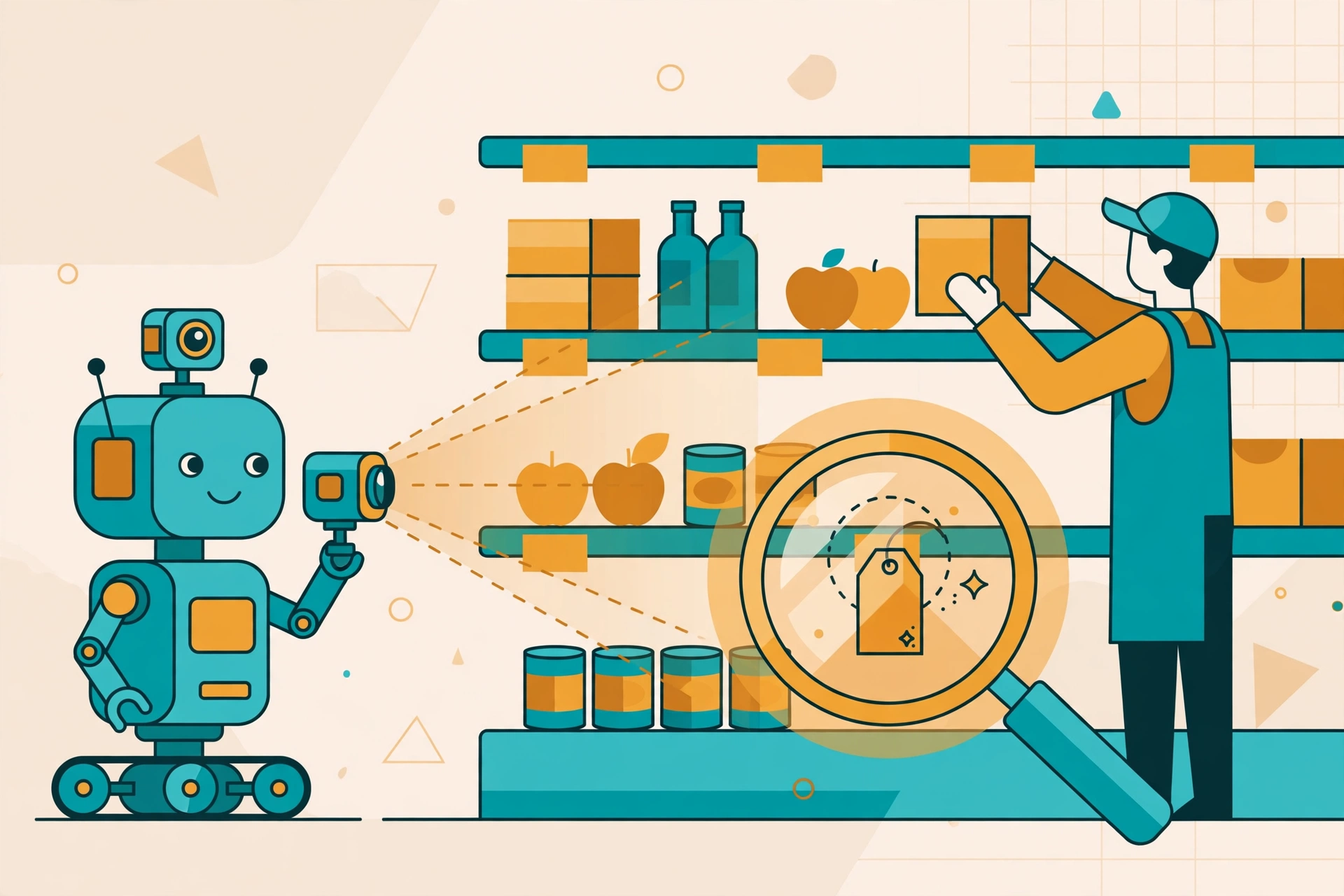
4. Simbe Robotics: the best AI shelf intelligence for fighting shrink
Simbe Robotics makes Tally, an autonomous robot that drives your aisles and photographs every shelf, and its Store Intelligence platform turns those images into the daily truth about your store: what is out of stock, what is misplaced, which price tags are wrong, and which planogram nobody followed. This is the shrink pick, and it attacks the problem from the opposite direction to everyone else on this list — not by forecasting demand, but by seeing the shelf.
The technology is computer vision at serious scale. Simbe Vision claims 99% shelf-label accuracy, trained on more than 60 billion shelf images and 18 million-plus unique SKUs. Tally has scanned more than 20 billion price tags and detected more than 731 million out-of-stock instances across more than 3,000 stores — all vendor-reported figures, but the scale is the point: this is not a pilot product. Customer studies cited by Simbe report out-of-stock rates falling 30–50% after deployment. The platform also covers the fresh perimeter — produce, deli, bakery, prepared foods — where Simbe says shrink runs highest, and Tally Spot fixed sensors add high-frequency monitoring for fast-selling items like rotisserie chickens and grab-and-go meals.
The honest limitation is format. Tally is built for grocery and larger-format stores; a 2,500-square-foot c-store with narrow aisles is a different deployment than a supermarket, so ask Simbe directly about small-format fit before you budget. If the robot does not fit your floor, Focal Systems’ fixed shelf cameras do the same job with cameras mounted on the shelf instead of a robot in the aisle — worth asking about as the alternative.
Pricing
- Quote only — Simbe says pricing is a subscription that varies by store count, store size, scanning frequency, and selected capabilities. No published prices.
Pros
- The only tool here that shows you the actual shelf, every day, instead of what your inventory system thinks is there
- 99% shelf-label accuracy claim, trained on a very large image dataset
- Turns shelf data into prioritized task lists, so staff fix the highest-value problems first
- Fresh department coverage targets the highest-shrink zone in the store
Cons
- Quote-only subscription pricing with no published floor
- Built for grocery-scale stores — small-format c-store fit needs confirming
- A robot in the aisle is a physical deployment, not just software, with space and charging needs
- Requires integration with your existing systems to turn shelf data into replenishment orders
5. Eagle Eye: the best AI-personalized loyalty and promotions for c-stores
Eagle Eye is a SaaS and AI company that builds loyalty, personalized promotions, and omnichannel marketing for retail — including grocers, convenience store groups, and consumer brands. Its customers include Loblaws, Giant Eagle, Wakefern, and Asda. If your c-store already has a loyalty program that sends every member the same coupon, Eagle Eye is the tool that makes it personal.
The product is EagleAI, and its Personalised Promotions feature uses AI and machine learning models powered by Google’s Vertex AI to create one-to-one offers for millions of shoppers in real time — an offer built for one specific customer, not the best-fitting offer from a pre-written list, with the retailer’s budget and business objectives acting as guardrails. Its Personalised Challenges feature — multi-step continuity offers — is credited by Eagle Eye with a 7:1 return on incremental sales to reward earned for retailers including Tesco, Morrisons, and Carrefour; that is a vendor-reported figure, not an independent benchmark. Eagle Eye says its AI models process 2.8 billion customer interactions per minute to power the next best personalized action for every customer — again, the vendor’s claim, but it signals the scale this is built for.
The trade-off is audience. Eagle Eye is built for enterprise retailers with large loyalty memberships and rich transaction data. A five-store operator with a punch-card program will not have the data volume for one-to-one AI offers to pay off, and should fix its loyalty basics first.
Pricing
- Quote only — Eagle Eye publishes no prices. Expect an enterprise SaaS agreement priced by membership size and modules.
Pros
- True one-to-one offers built by AI per customer, not segment-level coupons
- Personalised Challenges gamify loyalty with a vendor-reported 7:1 return
- Built for convenience store groups, not just grocery — the c-store use case is explicit
- Retailer guardrails keep AI offers inside your budget and margin rules
Cons
- Quote-only enterprise pricing
- Needs a large loyalty membership and rich transaction history to deliver value
- A separate loyalty platform means integration work with your POS
- The headline ROI figures are vendor-reported, not independently verified
How we picked
We scored the five tools on the three jobs that decide a c-store’s margin — forecasting and ordering, shrink, and loyalty — plus whether their AI features are real, named products rather than marketing labels. We weighted forecasting highest, because an ordering mistake repeats every day, and we required every tool to have a verifiable AI feature: a named product, a documented capability, or a public launch. That bar is why two familiar names are not on this list. Skupos is a scan-data and brand-promotions platform for independent c-stores, but we could not verify any AI product in it. Cantaloupe is a strong payments and vending management company, but its product is card readers and route software, not AI. Both are legitimate tools for a c-store — they just do not belong on an AI list. Pricing was checked against the vendors’ own sites and trade-press reporting in November 2026; confirm before you buy, because nearly everything here is quote-only. If you are building the customer-facing side of the operation, our guide to the best AI social media tools for small business covers promotion, our guide to the best AI review management software for local businesses covers local reputation, and our guide to the best AI customer support software for small business covers customer communication.
Frequently asked questions
What is the best AI tool for convenience stores?
For most operators, Upshop — its Demand IQ forecasting and AI Cockpit attack the ordering problem that costs c-stores the most money every day. Fuel and store operators who want one stack should look at PDI Technologies, and chains with a shrink problem should look at Simbe Robotics.
How much does AI software for a convenience store cost?
Almost every serious tool in this category is quote-only: PDI Technologies, Upshop, NCR Voyix, Simbe Robotics, and Eagle Eye all price by store count and modules, and none publishes a price. Expect an enterprise sales cycle and a quote — and be wary of any article that gives you a specific monthly number for one of these tools, because the vendor never published one.
Can AI really reduce shrink in a convenience store?
Yes, in two different ways. Shelf-intelligence tools like Simbe’s Tally robot spot out-of-stocks, misplaced products, and pricing errors the day they happen instead of weeks later — Simbe’s customer studies report out-of-stock rates falling 30–50% after deployment. And AI loyalty and forecasting tools reduce the other half of shrink: over-ordering perishables that expire before they sell.
Do I need a loyalty program before using AI promotions?
Yes. Tools like Eagle Eye build one-to-one offers from your transaction history, so they need a loyalty membership and purchase data to work with. If your store runs on punch cards or no loyalty program at all, fix that first — the AI has nothing to personalize without the data.
Is Skupos an AI tool for convenience stores?
Not in any verifiable sense. Skupos is a scan-data platform that connects independent c-stores with brands and distributors for scan data programs, brand-funded promotions, and rebates — useful, and priced from around $20 a month on directory listings — but we could not verify any AI feature or product in it, so it does not belong on an AI tools list. The same applies to Cantaloupe, which is payments and vending management rather than AI.



0 comments