5 Best AI Tools for Dental Practices in 2026
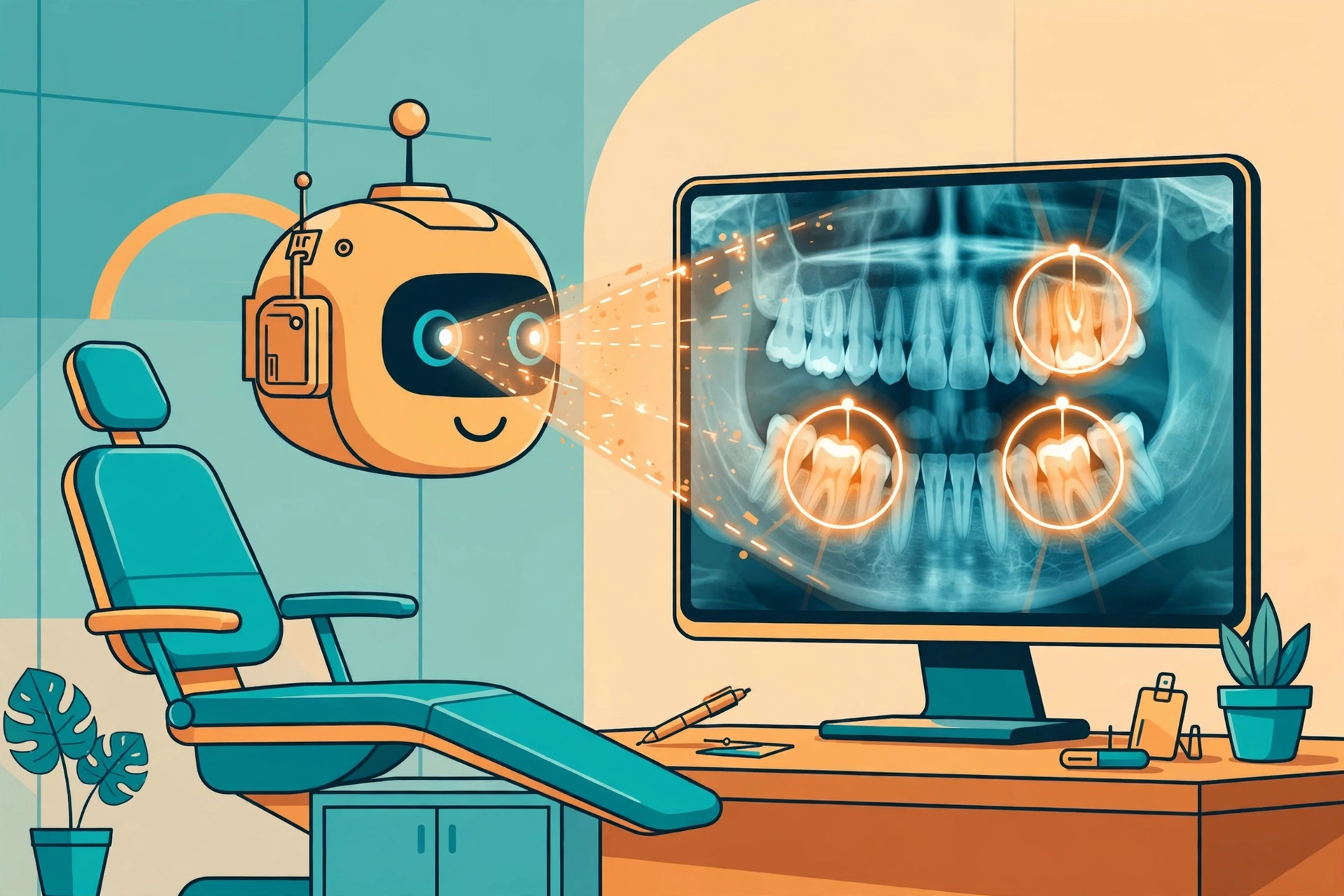
A dentist doesn’t buy dental AI — they buy two different things. The dentist buys imaging AI to catch what tired eyes miss at 4 PM on a Thursday and to show patients visible proof that treatment is needed. The office manager buys front-office AI to fill the schedule, chase no-shows, and stop the front desk from drowning in phone tag. If the phone is the biggest leak, see our best AI phone agents for small business guide — it compares the voice-AI front desks that answer after hours. Different buyers, different budgets, different ROI math — so this list is split into both categories instead of pretending they’re one purchase.
The first filter for any imaging tool is regulatory: in 2026, five dental AI platforms hold FDA 510(k) clearance for US practices, and that clearance line is the difference between a clinical tool and a liability question your malpractice insurer is starting to ask about. For front-office tools, the filter is simpler: does it plug into the practice management system you already run, and does it measurably move the no-show rate? Our top imaging pick is Pearl for the widest cleared detection coverage, and our top front-office pick is Weave for replacing three or four separate communication subscriptions in one platform.
Quick-Pick Summary
| Tool | Best For | Starting Price | Free Tier (Y/N) |
|---|---|---|---|
| Pearl | Single practices wanting the broadest cleared detection | ~$349/mo (via partner, no public list) | N — demo |
| Overjet | DSOs and multi-location groups standardizing care | Custom quote (~$1,000–2,000+/mo cited) | N — demo |
| VideaHealth | Dentrix Ascend practices (native Detect AI) | Custom quote (contact sales) | N — demo |
| Weave | Front-office phone, texting, reminders, reviews, payments | From $199/mo per location | N — demo |
| Bola AI | Voice clinical documentation and perio charting | Custom quote (per location) | N — demo |
Imaging AI: What the X-ray Sees First
1. Pearl — Second Opinion
Best for: Single-location practices that want one tool flagging the most conditions chairside.
Pearl‘s Second Opinion holds FDA 510(k) clearance K210365 for 2D radiograph analysis — the widest single-clearance pathology coverage of the imaging tools here: caries, periapical radiolucencies, calculus, crown and filling findings, implant and bridge findings, root canal findings, and restoration margin discrepancies. In May 2025 Pearl extended that clearance to Second Opinion 3D for CBCT scans, so both 2D and 3D imaging are covered. It integrates with Dentrix, Eaglesoft, Open Dental, Curve, and Carestack, and alongside the imaging product Pearl sells Practice Intelligence (clinical and operational analytics) and Precheck (AI insurance claim review). Pearl publishes no price list — pricing is contact-sales, with a third-party partner listing Second Opinion at $349 a month with no contract required, and volume-based pricing for larger organizations.
- Pricing: No published rate card; contact sales. Third-party partner pricing observed at ~$349/mo per location with no contract; DSO volume pricing negotiated. Confirm a current quote before budgeting.
- Pros: The broadest cleared pathology detection list of the three imaging tools; both 2D and 3D/CBCT covered under separate clearances; the widest PMS integration list (Dentrix, Eaglesoft, Open Dental, Curve, Carestack); visible AI overlays double as patient-education tools that raise treatment acceptance; companion products cover analytics and claims.
- Cons: No public pricing, so shopping means a sales process; setup fees reported in the $5,000–$20,000 range for some deployments; per-user/month subscription model can get expensive as staff count grows.
If you want the longest list of conditions flagged on every radiograph, it’s the pick.
2. Overjet
Best for: DSOs and multi-location groups that need standardized care and provider benchmarking across offices.
Overjet is the enterprise standard — the platform most large group practices have already vetted, which is its own kind of credential. It holds ten FDA clearances including Caries Assist (K222746), CBCT Assist (K251514), bone-level quantification at millimeter precision, and — uniquely — image enhancement that cleans up blurry or noisy X-rays without losing clinical detail. That measurement precision matters for perio case presentation: showing a patient a quantified bone level is a different conversation than gesturing at a dark spot. Overjet’s Chart Audit analyzes 12 months of historical radiographs to flag identified-but-unscheduled and missed treatment, producing a dollar view of unmet needs. Pricing is fully custom-quoted; third-party reviews cite roughly $1,000–$2,000+ a month for smaller practices, scaling with locations and modules.
- Pricing: Custom quote only; contact sales. Third-party sources cite ~$1,000–$2,000+/month for smaller practices. No public rate card.
- Pros: The only dental AI FDA-cleared to enhance images; millimeter-precision bone-level measurement for perio presentation; Chart Audit turns historical X-rays into recoverable production; the multi-DSO track record means a well-worn implementation process and deep PMS integrations (Dentrix, Dentrix Ascend, Eaglesoft, Denticon); HITRUST-certified security.
- Cons: The priciest imaging option here and the least transparent on cost — every quote is custom; clearly optimized for groups, so a single office may pay enterprise pricing for features scaled past it; no self-serve path to try before the sales process.
For a group standardizing diagnostics across locations, it’s the safe enterprise choice.
3. VideaHealth — Detect AI
Best for: Practices already running Dentrix Ascend, where it’s already inside the system.
VideaHealth holds FDA clearance from January 2024 covering more than 30 detections across caries, bone loss, calculus, and periapical lesions. Its distribution advantage is unique: it runs as Detect AI natively inside Dentrix Ascend, Henry Schein One’s cloud PMS. If your practice already runs Ascend, VideaHealth isn’t a third-party integration you have to manage — it’s already in your imaging workflow, and its Impact Panel (tooth damage percentages and bone-level summaries by quadrant) ships at no additional cost to Detect AI users. Pricing is contact-sales only, with no public price list.
- Pricing: Contact sales; no published pricing. Delivered as Detect AI embedded in Dentrix Ascend and via partner integrations.
- Pros: Zero-integration deployment for Dentrix Ascend practices; Impact Panel adds patient-facing education views at no extra cost; 30+ FDA-cleared detections; the Henry Schein One partnership means practices hear about it through their existing vendor relationship.
- Cons: Outside the Dentrix ecosystem the integration story is thinner than Pearl’s or Overjet’s; no public pricing means no comparison shopping; dataset-size claims can’t be independently verified from published sources.
On Ascend, VideaHealth is less a purchase decision than an activation. Everywhere else, shortlist Pearl or Overjet first.
Front-Office and Operational AI

4. Weave
Best for: Replacing the phone system, texting tool, reminder service, and review software with one platform.
Weave isn’t a single AI feature — it’s the front-office communications layer: VoIP phones, two-way texting, appointment reminders, online scheduling, digital forms, payments, and review requests in one subscription per location. That’s where the no-show math lives: automated reminder sequences at 72, 24, and 2 hours before appointments are what drag the industry’s 15–20% no-show rate down, and Weave bundles them with the phone the front desk already uses. Pricing starts at roughly $199 a month per location, with the Pro plan around $249 a month plus a roughly $750 one-time onboarding fee; the Elite plan (call analytics, expanded scheduling) isn’t publicly priced. It integrates with over 40 PMS and EHR systems including Dentrix, Eaglesoft, and Open Dental.
- Pricing: From ~$199/mo per location (Pro ~$249/mo, ~$750 setup fee). Annual contract; add-ons for forms, payments, and analytics push real costs higher. Elite tier not publicly priced.
- Pros: One subscription replaces four or five separate tools; missed-call texts and quick-fill lists recover revenue from calls the desk can’t reach; automated reviews feed Google visibility, which feeds new-patient flow; deep PMS integrations across 40+ systems.
- Cons: The real price is well above the headline once setup and add-ons land; per-location annual contracts scale fast for multi-office groups and carry early-exit penalties; some reviewers flag price creep over time; no free trial published.
If your front desk is juggling a phone system, a texting app, and a reminder service from three vendors, it consolidates the stack.
Try Weave For what the front desk does with phone support teams, our AI customer support software guide covers the multi-agent side.
5. Bola AI
Best for: Hygienists and dentists drowning in charting — voice documentation that feeds the PMS directly.
One honest note: Bola AI is not a front-office scheduling tool, even though it lands in roundups like this one. It’s voice AI for clinical documentation — voice perio charting and an AI scribe that writes clinical notes straight into your practice management software. That distinction matters because it’s scored on a different ROI: perio charting time (Bola AI reports practices saving around five minutes per perio chart), 50% more comprehensive perio charting completed, and higher SRP acceptance when patients hear measurements read aloud in real time. It integrates with Patterson Dental, Curve Dental, and Henry Schein PMS ecosystems. Pricing is custom-quoted per location and not publicly listed; third-party estimates put Voice Perio around $129–$250 a month per location and the full voice clinical suite around $300–$500+, with no setup fee typical.
- Pricing: Custom quote; no public price list. Third-party estimates: Voice Perio ~$129–$250/mo per location; full suite (perio + restorative + scribe) ~$300–$500+/mo. Confirm with a quote — treat estimates as estimates.
- Pros: Trained on dental vocabulary for real operatory conditions; hands-free charting keeps hygienists’ eyes on the patient; structured data flows into the PMS with no double entry; no setup fee typical, ~20-minute per-workstation onboarding.
- Cons: It’s documentation, not scheduling — it won’t fix your no-show rate or answer the phone; no public pricing; module-based quoting means the full suite can land at multiples of the entry estimate.
If charting eats your hygiene appointments, it pays for itself in recovered chair time.
How we picked these five
We split the evaluation on purpose, because the two categories have different buyers. Imaging tools were scored on (1) FDA 510(k) clearance status — verified clearance numbers where published, since clearance is the line between a clinical tool and a compliance risk; (2) integration depth with the major practice management systems (Dentrix, Dentrix Ascend, Eaglesoft, Open Dental); and (3) detection breadth. Front-office tools were scored on (1) scheduling and no-show reduction capability, (2) how many separate subscriptions they replace, and (3) PMS integration breadth. Pricing was checked against vendor pages and current third-party reporting in October 2026 — note that Pearl, Overjet, VideaHealth, and Bola AI all keep pricing behind sales, so treat their figures as starting points for a quote, not a rate card. One practical rule from practices that deploy well: start with one category and run it 60–90 days on measured baselines before adding the other. And confirm a signed Business Associate Agreement is in place before any patient data flows to a vendor — clearance covers the device, not your data handling.



0 comments