5 Best AI Tools for Ghost Kitchens in 2026
A ghost kitchen has no dining room, no walk-in traffic, and no host stand to smooth over a bad night. Every order arrives through a screen — DoorDash, Uber Eats, Grubhub, your own website — and every one of those screens takes a cut. The software on this list exists to do two jobs: pull all those orders into one place so your kitchen stops drowning in tablets, and get food out the door with your own drivers when the marketplaces cost too much. That is the whole buying decision, and it is a money decision before it is a technology decision.
Be honest about the “AI” label first. None of these five tools is a generative AI product. What they automate is order routing, menu syncing, and driver dispatch — decisions a dispatcher used to make by hand. That automation is worth real money in a kitchen running three virtual brands off one line, which is why we score it on its own terms and say plainly where a tool markets no AI features at all.
Our number one pick is Cuboh, because it publishes its prices, charges by how much you actually sell online, and lets you run unlimited virtual concepts from one kitchen. But if you need a full point of sale as well as aggregation, Otter’s Advanced plan is the better buy, and if you run your own drivers, VROMO is the cheapest way to dispatch them. Pricing was checked against the vendors’ own pricing pages in November 2026; confirm every figure with the vendor before you sign.
Quick-Pick Summary
| Tool | Best For | Starting Price | Free Tier |
|---|---|---|---|
| Cuboh | Single-kitchen operators running multiple virtual brands | $119/month (Low-Volume) | No |
| Otter | Kitchens that want POS and order aggregation in one system | $79/month per location (Starter) | No — free trial available |
| Deliverect | Multi-location chains and large virtual-brand groups | Quote only | No |
| Chowly | Toast or Square kitchens that want orders injected into their POS | Quote only | No |
| VROMO | Kitchens running their own delivery drivers | $99/month per location | No — 2-week free trial |
How We Ranked These Tools
We scored each tool on the four things that decide a ghost-kitchen purchase: how completely it merges delivery-app orders into one screen, how well it handles multiple virtual brands from one kitchen, whether it covers your own-driver dispatch, and the true monthly cost at realistic order volumes. We weighted pricing transparency heavily — a ghost kitchen runs on thin margins, and a quote-only vendor can hide a bill that eats them. We also separated genuine automation from marketing language: a tool gets credit for AI only where it actually automates a decision, such as routing an order or assigning a driver. Pricing was checked against the vendors’ own pricing pages in November 2026; where third-party listings conflicted with the vendor’s own page, we used the vendor’s page and said so.
1. Cuboh — Best Overall for Ghost Kitchens
Best for: A single kitchen running one or several delivery-only brands that wants published pricing and fast setup.
Cuboh is the most ghost-kitchen-shaped tool on this list. It was built to collapse the tablet farm — one device, one screen, with orders from every delivery app punched straight into your POS — and it prices itself by online-ordering revenue rather than by seats or locations. That matters for a kitchen whose volume swings with the season: you pay for the band you are actually in, not for capacity you are not using.
Pricing is published in full on Cuboh’s own pricing page, checked November 2026. Low-Volume costs $119 a month for up to $20,000 a month in online-ordering revenue. Mid-Volume costs $169 a month for $20,000 to $30,000. High-Volume costs $229 a month above $30,000. Enterprise pricing is custom for multi-location operators. Every plan includes unlimited virtual concepts, so three brands out of one kitchen cost the same as one. One warning: third-party listings such as G2 still show older figures of $80, $140, and $200 a month. Those are stale — the vendor’s own page now lists $119, $169, and $229, and that is the number to budget against.
The feature set is focused rather than broad. Cuboh consolidates orders, syncs menus across platforms, and pushes orders into your POS in real time. It does not sell you a POS, and it does not dispatch your own drivers — if you run a fleet, you will need a second tool for that, which is why VROMO sits at number five on this list. What Cuboh does, it does without a sales call, and for a one-kitchen operator that is the point.
Pricing: Low-Volume $119/month (up to $20k online revenue), Mid-Volume $169/month ($20k–$30k), High-Volume $229/month (above $30k); Enterprise custom. Vendor-published, checked November 2026. G2 lists older $80/$140/$200 figures — superseded by the vendor’s current page.
Pros:
- Published pricing with no sales call, banded by revenue so small kitchens pay less
- Unlimited virtual concepts on every plan — run several brands from one kitchen
- Purpose-built for delivery-only and ghost-kitchen operations
- Orders flow straight into your existing POS in real time
Cons:
- No POS of its own — you still need one
- No driver dispatch for your own fleet
- No free tier or free trial listed
- The revenue band can push you into the next tier in a strong month
2. Otter — Best All-in-One POS and Aggregation
Best for: Kitchens that want one system doing the POS, the aggregation, and the online ordering, with hardware included.
Otter is the only tool here that replaces your POS instead of sitting on top of it. Its bundles combine POS software, hardware, delivery-app aggregation, and online ordering in one per-location price, which makes it the simplest stack on this list — one vendor, one bill, one support line. For a ghost kitchen starting from scratch, that simplicity is worth a lot. For a kitchen that already has a POS it likes, it is a reason to look at Cuboh instead.
Pricing is published per location on Otter’s own pricing page, checked November 2026. Starter costs $79 a month per location and covers POS software with a terminal, Bluetooth printer, and card reader. Advanced costs $178 a month per location and adds delivery-app aggregation, online ordering, and QR ordering — the tier a ghost kitchen actually needs. Professional costs $278 a month per location and adds a website builder, loyalty, and gift cards. Every tier carries a transaction fee on top: card-present rates run 2.79% + $0.20 on Starter, 2.59% + $0.15 on Advanced, and 2.39% + $0.10 on Professional, with card-not-present at 3.29% + $0.30 across tiers. Two costs catch people out. Hardware comes on a 24-month lease, not as a purchase, and locations under $25,000 in monthly card volume face a $100 minimum monthly processing fee.
On AI: Otter markets native multichannel order management rather than generative AI. Its automation is real — orders from every channel land on one dashboard and sync automatically — but buy it for the all-in-one stack, not for an AI story.
Pricing: Starter $79/month per location; Advanced $178/month per location; Professional $278/month per location. Transaction fees extra (2.79%–2.39% + $0.10–$0.20 card-present by tier). Hardware on a 24-month lease; $100/month minimum processing fee under $25k monthly card volume. Vendor-published, checked November 2026.
Pros:
- One system for POS, aggregation, and online ordering — no second vendor
- Hardware bundled into the monthly price at every tier
- Published pricing and published processing rates by tier
- Native delivery aggregation built in, not bolted on
Cons:
- Advanced at $178 a month is the real entry point for a ghost kitchen; Starter is POS-only
- A transaction fee sits on top of every plan, plus a $100 monthly processing minimum for small locations
- Hardware is leased for 24 months, not owned
- Per-location pricing gets expensive across several kitchen sites
3. Deliverect — Best for Multi-Location Chains
Best for: Chains and large virtual-brand groups that need deep integrations and enterprise-grade order management.
Deliverect is the enterprise end of this market. It connects delivery apps to your POS, pushes one menu out to every platform, and adds its own direct-ordering channel (Deliverect Direct) and last-mile dispatch (Deliverect Dispatch) on the same system. The vendor reports more than 1.5 billion orders processed across 80,000 locations, and its customer list runs to KFC, Pizza Hut, and Burger King. If you operate ten kitchens, that scale is the argument. If you operate one, it is overkill — and the pricing will tell you so.
Deliverect does not publish prices on its main pricing page: every account is quoted, based on location count, scale, and which products you take. That is the honest headline, and any list that prints a single Deliverect price without saying where it came from is guessing. A third-party listing (Back of House) shows US aggregation starting at $99 a month, with Deliverect+ at $30 a month extra, Direct at $99 a month, and Dispatch at $39 a month — but that is a reseller-style listing, not the vendor’s published price, so treat it as a floor for the conversation, not a quote. Expect an annual contract, a one-time setup fee, and up to 90 days’ notice to cancel.
The feature set is the deepest here: 1,000-plus integrations, real-time menu sync, Sentinel monitoring that watches for marketplace downtime and reopens locations automatically, and refund and dynamic-pricing analytics on the Plus tier. For a single-kitchen operator, that depth is mostly unused. For a group running virtual brands across cities, it is the reason to take the sales call.
Pricing: Quote only — no published prices on the vendor’s pricing page. A third-party listing shows US aggregation from $99/month, but that figure is not vendor-published. Expect an annual contract, a one-time setup fee, and transaction fees on top. Checked November 2026.
Pros:
- The deepest integration library here — 1,000-plus POS and delivery connections
- Built for multi-location scale, with menu sync and downtime monitoring across sites
- Direct ordering and dispatch available on the same platform
- Proven at very high order volumes with major chains
Cons:
- Quote-only pricing with annual contracts — no way to budget without a sales call
- Setup fees and transaction fees sit on top of the subscription
- Overbuilt and overpriced for a single-kitchen operator
- Cancellation requires up to 90 days’ notice
4. Chowly — Best POS Injection for Toast and Square Kitchens
Best for: Independent US restaurants and small groups already on Toast, Square, or Clover that want delivery orders injected into their POS.
Chowly’s pitch is narrower than the others, and for a lot of kitchens that is exactly right. It does one job: take Uber Eats, DoorDash, and Grubhub orders and inject them directly into your POS ticket stream, so the kitchen printer sees one queue instead of five tablets. Menus sync one way, from POS to marketplaces, and direct orders through its white-label site carry no commission. It also layers in loyalty and marketing tools for operators who want them.
Chowly does not publish pricing — every account is quoted. Third-party reports disagree on the range: one recent comparison puts typical pricing at about $80–$120 a month per location, another at $80–$150-plus, and older operator reports cite $400–$500 a month. The honest reading is that Chowly’s price depends heavily on your POS, your marketplaces, and your volume, and the only reliable number is the one on your own quote. Reported setup fees run $150–$500 depending on POS complexity, and contracts are generally month-to-month, which softens the risk of the opaque pricing.
The catch is fit. Chowly assumes you already have a POS you like — Toast, Square, Clover — and it works best inside those ecosystems. A ghost kitchen building from scratch gets more from Otter’s all-in-one bundle or Cuboh’s published pricing. But if your POS is settled and the tablet farm is the problem, Chowly solves that problem with the least disruption of any tool here.
Pricing: Quote only — Chowly does not publish prices. Third-party reports put typical pricing at roughly $80–$150 a month per location, with older operator reports higher; setup fees reported at $150–$500. Get a written quote before budgeting. Checked November 2026.
Pros:
- Orders inject directly into your existing POS — no new system to learn
- Works with the POS systems most US kitchens already run: Toast, Square, Clover
- Direct orders through its white-label site are commission-free
- Generally month-to-month, with no long contract
Cons:
- No published pricing — you cannot compare it without a sales call
- Third-party price reports vary widely, from about $80 to $500 a month
- Assumes you already have a POS; it is not a standalone system
- No driver dispatch of its own
5. VROMO — Best for Running Your Own Drivers
Best for: Ghost kitchens that deliver with their own riders and want to stop paying marketplace commission on every order.
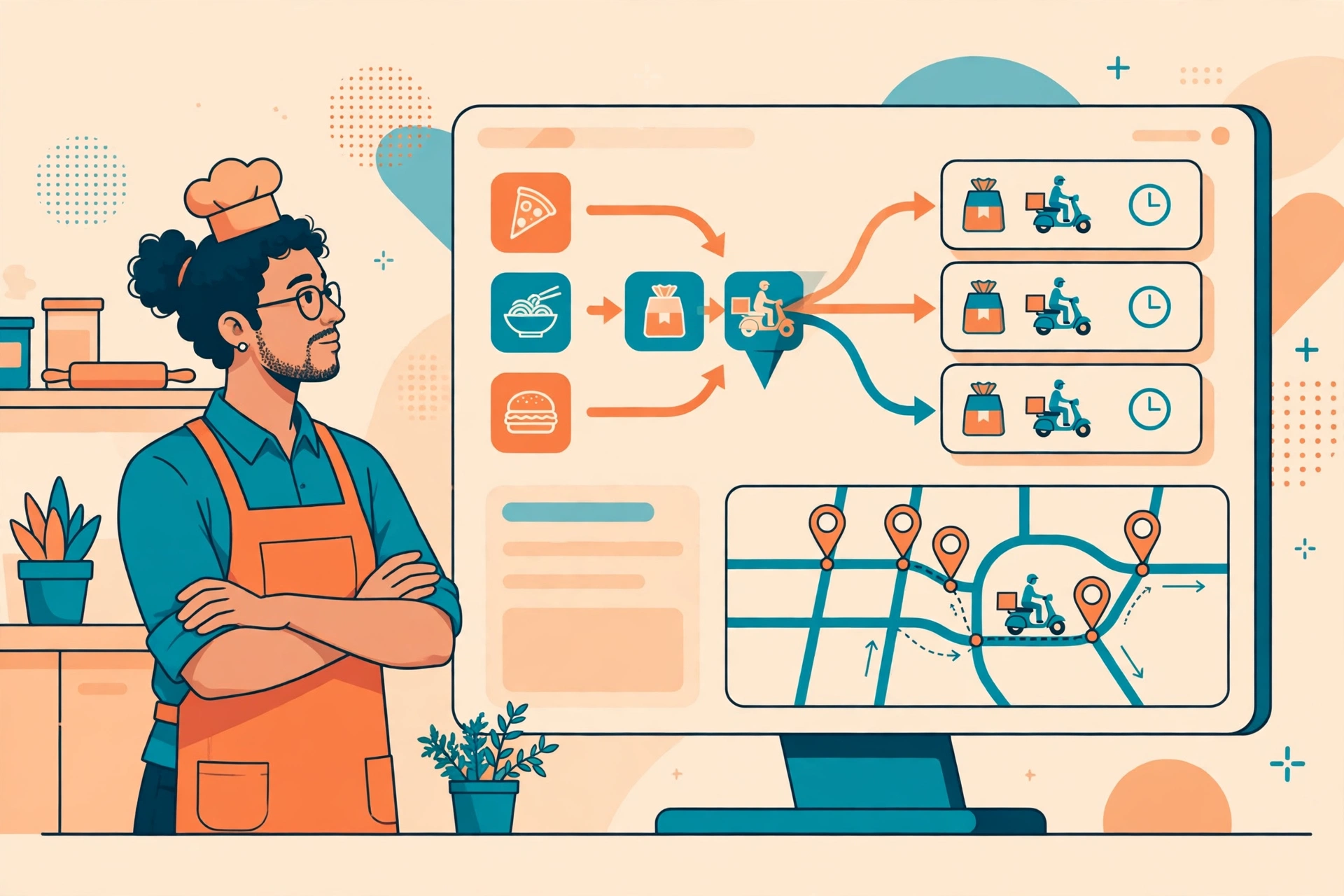
The first four tools on this list manage orders coming in. VROMO manages orders going out. It is dispatch software for your own fleet: auto-dispatch with custom business rules, order stacking so one rider carries several deliveries on a single route, overflow routing to partner fleets at discounted rates when your own riders are maxed out, and live driver tracking for the customer. Its own pricing page states the same subscription applies whether you are a customer-facing restaurant or a dark kitchen — no dark-kitchen surcharge.
Pricing is published on VROMO’s own pricing page, checked November 2026: $99 a month per location, including your first 400 deliveries, plus $0.25 per order above 400. A two-week free trial is available, and enterprise pricing is custom. Note the conflict: G2 and SourceForge list VROMO at $129 a month with 370 orders included and $0.35 per extra order. Those listings are stale — the vendor’s own pricing page lists $99, 400 orders, and $0.25, and that is the figure to use.
The economics are the argument. At 400 deliveries a month, VROMO costs $99. At 1,000 deliveries, it costs $99 plus 600 × $0.25, or $249. Compare that with DoorDash’s marketplace commission — 15% on Basic, 25% on Plus, 30% on Premier — and a $25 average order on Plus costs $6.25 in commission alone. A kitchen doing 1,000 of its own deliveries a month through VROMO pays $249 in software; the same 1,000 orders on DoorDash Plus would cost $6,250 in commission. The catch, of course, is that you have to find the customers yourself — VROMO brings no demand, only dispatch.
Pricing: $99/month per location, first 400 deliveries included, then $0.25 per order; 2-week free trial; Enterprise custom. Vendor-published, checked November 2026. G2 lists an older $129/month figure — superseded by the vendor’s current page.
Pros:
- The cheapest dispatch on this list, with a transparent per-order overage
- Order stacking and overflow routing cut the cost of your own fleet
- Same price for dark kitchens as for dine-in restaurants
- SMS and in-app calls included — no surprise telephony charges
Cons:
- Dispatch only — it does not aggregate marketplace orders or run a POS
- No free tier, only a two-week trial
- Per-order fees add up at very high volumes
- Brings no customer demand; you need your own ordering channel
What a Ghost Kitchen Actually Pays: Aggregation vs Marketplace Commission
The number most ghost-kitchen owners get wrong is not the software bill — it is the commission bill. Aggregation software and marketplace commission are two different charges, and confusing them is how a kitchen ends up paying both without noticing. The aggregation tool (Cuboh, Otter, Deliverect, Chowly) is a flat monthly fee. The marketplace (DoorDash, Uber Eats, Grubhub) takes a percentage of every order that comes through its app. DoorDash’s published merchant plans run Basic at 15% commission, Plus at 25%, and Premier at 30% on delivery orders, with 6% on pickup orders across all three plans.
Run the math on 1,000 orders a month at a $25 average ticket — $25,000 in delivery sales:
| Cost | Amount |
|---|---|
| Cuboh Mid-Volume (at $25k online revenue) | $169 |
| DoorDash Basic (15%) | $3,750 |
| DoorDash Plus (25%) | $6,250 |
| DoorDash Premier (30%) | $7,500 |
| VROMO dispatch for 1,000 own-driver orders | $249 |
Two things jump out. First, the aggregation software is the smallest line on the bill — $169 against thousands in commission — so picking the cheapest aggregator saves tens of dollars while the commission tier costs thousands. Second, every order you move from a marketplace to your own channel, dispatched through VROMO, keeps roughly $6 of every $25 in your pocket instead of DoorDash’s. That is why the strongest stack on this list is not one tool but two: an aggregator for marketplace orders, plus a direct-ordering channel and VROMO for your own deliveries. ItsaCheckmate is worth a mention here too: it is another established aggregator, trusted by more than 21,000 restaurants per its own site, but it is quote-only and third-party listings put its starting price around $85 a month — it belongs on your shortlist if Cuboh’s revenue bands do not fit.
How We Picked
We compared tools that serve delivery-only and ghost-kitchen operators on order aggregation depth, multi-brand handling, own-driver dispatch, and true monthly cost at realistic order volumes. We weighted pricing transparency heavily, because a ghost kitchen’s margins leave no room for a surprise quote. We credited AI only where a tool actually automates a decision — order routing, menu syncing, driver assignment — and said so plainly where a tool markets no generative AI features. Pricing was checked against the vendors’ own pricing pages in November 2026; where third-party listings conflicted with a vendor’s page, we used the vendor’s page and noted the conflict. Pricing checked November 2026; confirm before you buy.
If you run a food business with a dining room too, our guides to the best AI tools for restaurants and the best AI tools for food trucks cover POS and front-of-house software this list deliberately leaves out. And if your kitchen also takes phone orders after hours, our guide to the best AI customer support software for small business covers AI answering for missed calls.
Frequently Asked Questions
What is the best software for a ghost kitchen?
For most single-kitchen operators, Cuboh is the strongest pick: published pricing from $119 a month, unlimited virtual concepts, and orders pushed straight into your POS. If you need a POS as well as aggregation, Otter Advanced at $178 a month per location is the better buy. Multi-location groups should take the Deliverect sales call.
How much does ghost kitchen software cost per month?
Published starting prices run from $79 a month (Otter Starter, POS-only) to $119 a month (Cuboh Low-Volume), with VROMO dispatch at $99 a month per location. Deliverect and Chowly are quote-only. The software is the small part of the bill — DoorDash takes 15% to 30% of every marketplace order on top.
Do ghost kitchens need a POS and an aggregator?
Not always both. Otter bundles POS and aggregation in one system, so one subscription covers both. Cuboh, Deliverect, and Chowly sit on top of a POS you already have — Cuboh and Deliverect push marketplace orders into it, Chowly injects them into the ticket stream. If you already run Toast or Square, an aggregator alone is enough.
What is the difference between an aggregator and a marketplace commission?
An aggregator is software you pay monthly — $119 to $229 a month at Cuboh, for example — to pull orders from every delivery app onto one screen. A marketplace commission is a percentage of each order: DoorDash charges 15% on Basic, 25% on Plus, and 30% on Premier. You pay both on marketplace orders, which is why moving orders to your own channel saves far more than picking a cheaper aggregator.
Can one kitchen run several virtual brands?
Yes — that is the core ghost-kitchen model. Cuboh includes unlimited virtual concepts on every plan, so three brands out of one kitchen cost the same as one. Deliverect and ItsaCheckmate also support multi-brand operations, and VROMO charges the same dispatch price for dark kitchens as for dine-in restaurants.



0 comments